Technical Documents
Specifications
Product Details
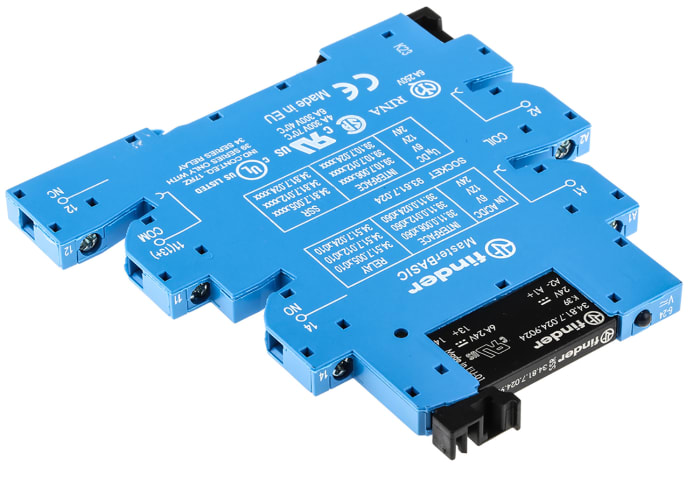
This solid state interface relay is a reliable solution designed for electronic control systems. With a compact DIN rail mounting design, it facilitates easy integration into various applications. It operates within a control voltage range of 19.2V to 26.4V and can handle load currents of up to 6A, optimising performance in a variety of environments.
The relay is rated for a maximum current of 6A, making it suitable for high current applications while maintaining efficiency with minimal heat generation. This is particularly important in automation where timing and load management are critical.
With an off-state leakage current of only 0.001mA, it minimises energy loss when not in use, which can significantly reduce overall energy expenditure in long-term applications.
Yes, it serves as an effective interface between various devices, such as sensors and controllers, allowing for seamless integration into PLC-based systems while enhancing operational capabilities.
Stock information temporarily unavailable.
€ 48.28
€ 48.28 Each (ex VAT)
1
€ 48.28
€ 48.28 Each (ex VAT)
Stock information temporarily unavailable.
1
| Quantity | Unit price |
|---|---|
| 1 - 4 | € 48.28 |
| 5 - 9 | € 46.83 |
| 10+ | € 44.81 |
Technical Documents
Specifications
Product Details
This solid state interface relay is a reliable solution designed for electronic control systems. With a compact DIN rail mounting design, it facilitates easy integration into various applications. It operates within a control voltage range of 19.2V to 26.4V and can handle load currents of up to 6A, optimising performance in a variety of environments.
The relay is rated for a maximum current of 6A, making it suitable for high current applications while maintaining efficiency with minimal heat generation. This is particularly important in automation where timing and load management are critical.
With an off-state leakage current of only 0.001mA, it minimises energy loss when not in use, which can significantly reduce overall energy expenditure in long-term applications.
Yes, it serves as an effective interface between various devices, such as sensors and controllers, allowing for seamless integration into PLC-based systems while enhancing operational capabilities.