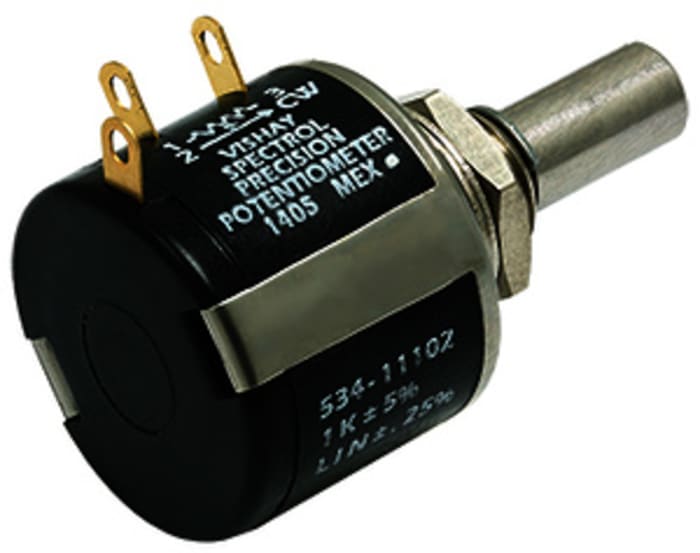
RS PRO NHP22 1 kΩ Rotary Potentiometer 10-Turns 1-Gang Panel Mount

Technical Document
Specifications
Brand
RS ProProduct Type
Potentiometer
Potentiometer Type
Rotary
Maximum Resistance
1kΩ
Shaft Diameter
6.35mm
Number of Gangs
1
Number of Turns
10
Power Rating
2W
Electrical Taper
Linear
Element Material
Wirewound
Mount Type
Panel Mount
Termination Style
Solder
Shaft Length
20.5mm
Adjustment Type
Side
Pin Count
3
Minimum Operating Temperature
-40°C
Maximum Operating Temperature
125°C
Height
29.5mm
Depth
23.2mm
Length
39mm
Standards/Approvals
RoHS
Tolerance ±
10%
Series
NHP22
Mounting Hole Diameter
10.32 mm
Actuator Type
Round Shaft
Product details
RS PRO Wirewound Rotary Potentiometers
Brought to you by RS PRO, these multi-turn wirewound potentiometers offer a range of resistance options between 1 kΩ and 10 kΩ. The 6.35 mm diameter shaft will provide a rotational life of over 1 million revolutions, making them perfect for applications requiring constant use. Comes complete with a 3600° mechanical rotation and an end stop, perfect for use on PCB boards or other electronics. All models are highly reliable and excellent quality.
Features and Benefits
• Robust construction
• Standard resistance tolerance of ±10%
• Electrical life of 1,000,000 strokes
• 6.35 mm diameter shaft
• 10 turn build
What is a potentiometer?
A potentiometer is a variable resistor which increases or decreases the resistance in an application. Usually available as either digital or analogue, there are two main types of potentiometers, rotary and linear.
• Linear - comes in a rectangle strip shape and can be pulled up or down for the required resistance, Used a lot within sound systems for mic output or volume control.
• Rotary - the shaft is housed by a knob, you would find these on dimmer switches or speakers, turning (usually to the right) will increase the resistance amplifying the output, whether that is light, sound or voltage.
How do potentiometers work?
Used in various applications, potentiometers operate as a resistor for electronic devices. As an example, a dimmer switch you would find in place of a light switch would house a potentiometer. Whichever direction it is turned, either increases or decreases the resistance, manipulating the light output from the bulb. Another common use would be speaker or sound systems, operating as a volume switch. There are various types of element material, usually as rotary or linear, such as:
• Wire-wound
• Conductive
• Plastic
• Carbon
• Cermet

Stock information temporarily unavailable.
€ 296.38
€ 5.928 Each (In a Box of 50) (ex VAT)
50
€ 296.38
€ 5.928 Each (In a Box of 50) (ex VAT)
Stock information temporarily unavailable.
50
| Quantity | Unit price | Per Box |
|---|---|---|
| 50 - 50 | € 5.928 | € 296.38 |
| 100 - 200 | € 5.773 | € 288.65 |
| 250 - 450 | € 5.624 | € 281.22 |
| 500+ | € 5.483 | € 274.13 |
Technical Document
Specifications
Brand
RS ProProduct Type
Potentiometer
Potentiometer Type
Rotary
Maximum Resistance
1kΩ
Shaft Diameter
6.35mm
Number of Gangs
1
Number of Turns
10
Power Rating
2W
Electrical Taper
Linear
Element Material
Wirewound
Mount Type
Panel Mount
Termination Style
Solder
Shaft Length
20.5mm
Adjustment Type
Side
Pin Count
3
Minimum Operating Temperature
-40°C
Maximum Operating Temperature
125°C
Height
29.5mm
Depth
23.2mm
Length
39mm
Standards/Approvals
RoHS
Tolerance ±
10%
Series
NHP22
Mounting Hole Diameter
10.32 mm
Actuator Type
Round Shaft
Product details
RS PRO Wirewound Rotary Potentiometers
Brought to you by RS PRO, these multi-turn wirewound potentiometers offer a range of resistance options between 1 kΩ and 10 kΩ. The 6.35 mm diameter shaft will provide a rotational life of over 1 million revolutions, making them perfect for applications requiring constant use. Comes complete with a 3600° mechanical rotation and an end stop, perfect for use on PCB boards or other electronics. All models are highly reliable and excellent quality.
Features and Benefits
• Robust construction
• Standard resistance tolerance of ±10%
• Electrical life of 1,000,000 strokes
• 6.35 mm diameter shaft
• 10 turn build
What is a potentiometer?
A potentiometer is a variable resistor which increases or decreases the resistance in an application. Usually available as either digital or analogue, there are two main types of potentiometers, rotary and linear.
• Linear - comes in a rectangle strip shape and can be pulled up or down for the required resistance, Used a lot within sound systems for mic output or volume control.
• Rotary - the shaft is housed by a knob, you would find these on dimmer switches or speakers, turning (usually to the right) will increase the resistance amplifying the output, whether that is light, sound or voltage.
How do potentiometers work?
Used in various applications, potentiometers operate as a resistor for electronic devices. As an example, a dimmer switch you would find in place of a light switch would house a potentiometer. Whichever direction it is turned, either increases or decreases the resistance, manipulating the light output from the bulb. Another common use would be speaker or sound systems, operating as a volume switch. There are various types of element material, usually as rotary or linear, such as:
• Wire-wound
• Conductive
• Plastic
• Carbon
• Cermet